Understanding Behavioral Health Funding in Pierce County
By Bryan Dominique, Communications Director – Pierce County Council
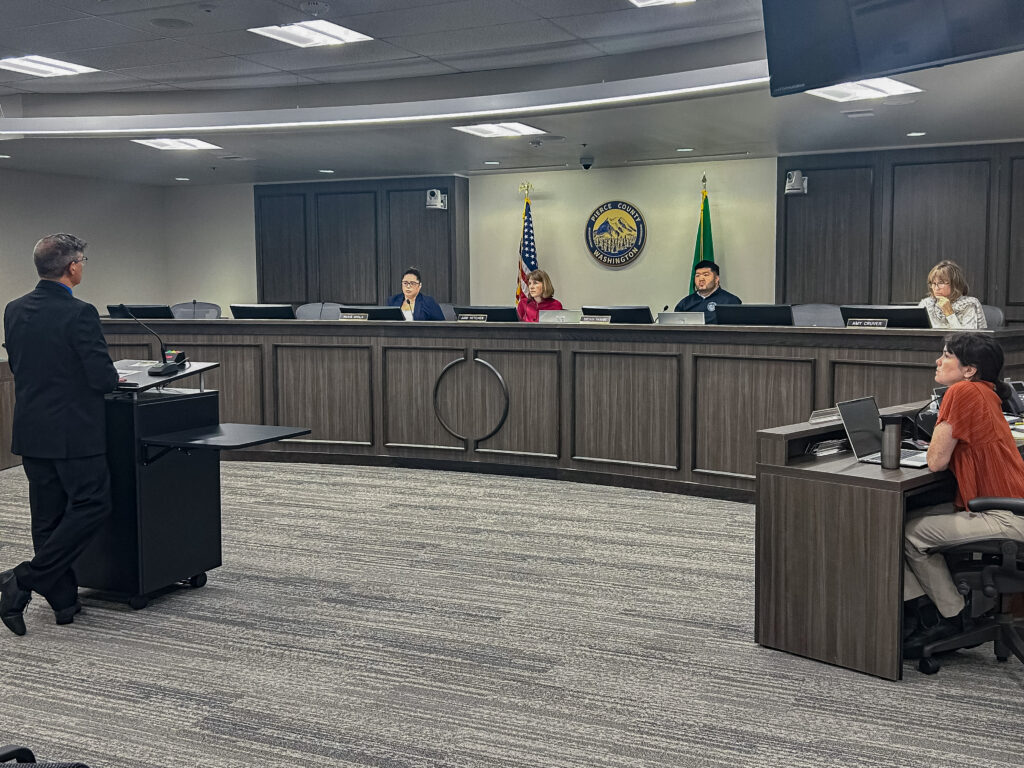
If someone described September as Behavioral Health Month in Pierce County, they wouldn’t be wrong, exactly. Since September 1, the Council or its committees have had a substantive behavioral health agenda item each week.
The throughline is funding: where behavioral health funding comes from, how much the county actually controls, and whether it’s reaching people.
“Our behavioral health system in Washington is primarily a Medicaid system,” said Kevin Black, Strategic Advisor on Behavioral Health to the Executive, at the Sept. 15 Health and Human Services Committee.
Black stressed that Pierce County controls about 10% of all behavioral health dollars, and likely less of the dollars actually spent on behavioral health in the county. As a result, the Council can focus on improving the system through clear legislative and policy priorities, making effective use of the local behavioral health tax dollars the county does control, and working with partners on system improvements.
Toward that, Pierce County is interested pursuing state legislation to expand Medicaid coverage for high-intensity outpatient and partial hospitalization treatment for substance use disorders and expand police detention and transport authorities to include firefighters and other first responders.
Efforts are also underway to improve the 988 (behavioral health crisis line)-911 (emergency reporting line)relationship and strengthen partnerships with the City of Tacoma to reduce service silos and clarify the pathway for the county to assume administration of Behavioral Health Administrative Services Organization funds.
Behavioral Health & Therapeutic Court Tax
The county controls about $28 million in local dollars generated from a one-tenth of one percent sales tax, or a penny per $10 purchase. Pierce County’s Behavioral Health Tax, adopted by the Council in December 2020 and effective July 2021, is set to expire at the end of 2027.
By state law, Pierce County can only spend collected funds on mental health treatment, substance use treatment, and therapeutic court programs, with spending fitting into three categories: professional-services contracts, administrative/overhead costs, and transfers to other county departments.
Human Services staff described the history of expenditures from these funds at a Committee of the Whole meeting on Wednesday, September 9, highlighting that the county previously ran one bundled procurement per cycle, but in the 2026-2027 biennium, switched to seven targeted RFPs aligned to the Behavioral Health Improvement Plan (BHIP), awarding 27 contracts worth just over $20M to community agencies. This represents the largest share to youth behavioral health and outpatient mental health, with more for prevention, veterans, housing, peer services, and justice-involved populations. About an additional $9.3M went out by direct allocation to government partners.
“I think this really maps back to we have this behavioral health improvement plan that’s talking about how we can improve access to services, people getting treatment they need, avoiding crisis care as much as possible. We do more early intervention work and prevention work,” said Margo Burnison, Human Services Division Manager. “So, I think that’s really why we handled the procurement the way that we did this time, to make sure that all those areas that we really care about—making sure that youth are getting served, that people upon reentry have services, that people who are unstably housed, who we know often struggle with mental health, also have services available to them.”
Pierce County leverages its limited behavioral health dollars to fill gaps where Medicaid does not maximize access to services. The county has also moved toward performance-based contracting with agreed-upon goals and milestones.
According to the Chief Executive Officer of Comprehensive Life Resources, this approach makes it easier to blend the funding.
“Our contracts say these are the things we’re committed to do—this many groups, this many kids, this percentage of people will be open in Medicaid. If we don’t achieve our milestone, we don’t get paid, and we’re okay with that; it’s much better for us to blend the funding when that’s how we’re doing it,” said Kim Zocker.
Other Local Funds
The Pierce County Council approved a $3 million capital award to build a new licensed assisted living facility in Tacoma that will provide continuous care and support for more than 100 people with complex behavioral health needs, on Sept. 1.
The intent of Resolution No. R2026-178 is to expand access to stable, community-based housing for people who need ongoing support to live safely. Trouvés Healthcare opened St. Ann’s in 2019, and as a licensed assisted living facility, St. Ann’s provides a stable home for residents transitioning directly from state hospitals and acute care centers.
“The world of behavioral health is complicated, and even more so for community members who struggle to maintain stable and supportive housing. This keeps hospital beds open for life-threatening emergencies and brings stability to those most in need,” said Councilmember Rosie Ayala (District 4). “Trouves brings together basic needs with mental and behavioral health supports in one place, and I am excited for more people to get the services they deserve.”
Pierce County’s $3 million investment comes from the Maureen Howard Affordable Housing Act, a dedicated local sales tax that funds affordable housing and related services for people experiencing or at risk of homelessness, as well as other residents facing significant barriers to stable housing. At least 60% must be used to construct or acquire affordable housing, mental/behavioral health facilities, or fund operations and maintenance for facilities serving individuals with incomes at or below 60% of the area median income.
“The Council will continue its work to understand behavioral health services and the funding role that the county plays,” said Council Chair Jani Hitchen (District 6). “Our goal is a behavioral health system that consistently delivers for the residents of our community.”